
Estimated reading time: 4 minutes
Reading a pace clock in swimming can be a bit confusing at first, but once you get the hang of it, it becomes a valuable tool for tracking your laps and improving your swimming performance. Here’s a step-by-step guide to help you understand how to read and use a pace clock:
When you purchase through links on our site, we may earn affiliate commissions. Also as an Amazon Associate, I earn from qualifying purchases. Here’s how it works.
Understanding the Pace Clock
What Are The Types of Pace Clocks?
Analog Pace Clock
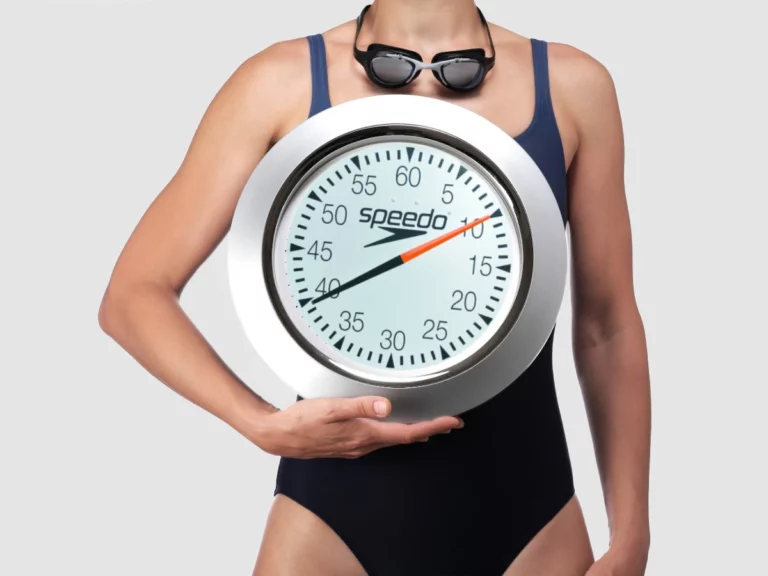
It looks like a traditional clock with a large hand (second hand) that rotates every 60 seconds and a smaller hand (minute hand) that tracks minutes.

Digital Pace Clock
Displays time in minutes and seconds, often in a large, easy-to-read format.

Understanding The Terminology
At The Top
The starting point is usually at the “60” or “0” second mark, which is “at the top” of an analog clock. On a digital clock, however, this represents the time when the last 2 digits are “X:00” of the expected interval.
On The 15
Quite simply, this describes starting at the 15 minute mark.
At The Bottom
Similar to “At The Top,” this is when your interval is to start at the 30 minute mark.
On The 45
Quite simply, this describes starting at the 45 minute mark.
Using the Pace Clock
Starting Your Swim
Choosing a start time on the clock is typically set by the coach. For example, you might told to start your swim or leave “at the top.” This means that you push off of the wall when the analog clock reaches the “0” mark or the digital clock reads “X:00.”
Tracking Your Laps
Analog Clock
As you complete each lap or interval, note the position of the second hand. If you started at the “0” second mark and completed a lap when the hand is at “40”, your lap time is 40 seconds.
Digital Clock
Note the time displayed when you start and when you finish. For example, if you start at 2:15 and finish at 3:00, your lap time is 45 seconds.
Interval Training
For interval training, set a specific time to rest between sets.
Example
If you’re doing 50-meter repeats with 10 seconds rest, and you swim each 50 meters in 45 seconds, you’ll start each new lap every 55 seconds (45 seconds swim + 10 seconds rest).
If your coach has you swim 5, 100 M Freestyle on 1:15. What that means is that you will do 5 rounds of 100 M freestyle. If you swim 100M Free in practice at 58 seconds, you will have about 17 seconds rest between swims. If you start on the 15, you would finish your round and leave the next time the clock reads 30.
Tips for Using the Pace Clock
Consistent Timing
Always start your laps at easily recognizable positions on the clock, such as the “0”, “15”, “30”, or “45” second marks.
Counting Laps
Keep track of the number of laps you’ve swum by noting the minute hand’s position. If you swim a lap in 1 minute, the minute hand will move accordingly.
Pacing Yourself
Use the pace clock to maintain consistent lap times. If your goal is to swim 100 meters in 2 minutes, check the clock to ensure each 50-meter lap is around 1 minute.
Practice
Spend some time practicing with the clock outside of your regular workout. Get used to glancing at it quickly and interpreting the time so it becomes second nature.
By understanding these basics, you’ll be able to use the pace clock effectively to monitor your swimming progress and improve your times. Happy swimming!
