
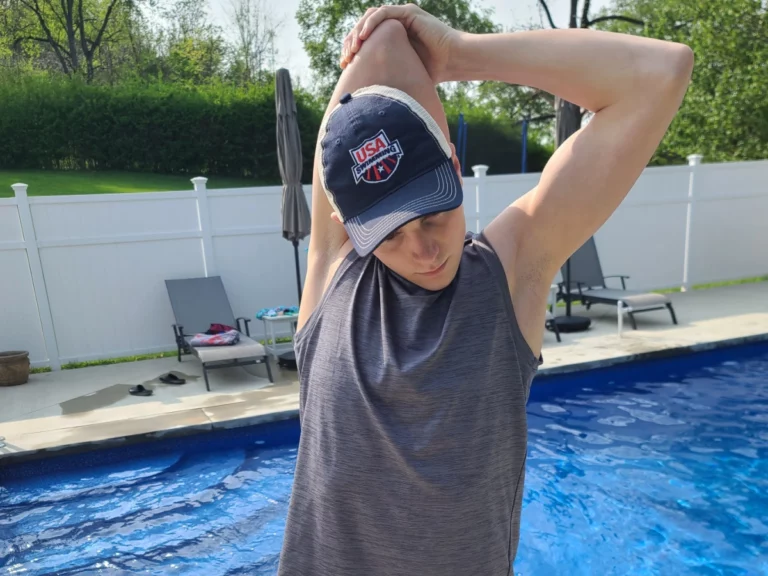
Sooner or later every swimmer is going to end up with shoulder pain. In fact, there are several over-use type injuries in the category of Swimming Injuries. In this post, I’m going to explain how to identify and manage the most common complaint of competitive swimmers, Swimmer’s Shoulder.
What is Swimmer’s Shoulder?
Simply put, Swimmer’s Shoulder is where specific soft tissue structures in the front and side of the shoulder joint are pinched or impinged and inflamed.
Because swimming requires repetitive use of the muscle groups in the front of the shoulder, an imbalance eventually occurs in the muscles making up the “Rotator Cuff.”
The upper arm is pulled forward, causing a joint misalignment that eventually leads to swelling and pain as the soft tissue impinges with each forward movement of the arm. Because of this, it is also referred to as Shoulder Impingement Syndrome.

Swimmer’s Shoulder Symptoms
Typically a swimmer will likely complain of pain in the top, and front of the shoulder that can extend just slightly to the side that can come on gradually or suddenly.
Simply, raising the arm forward and to the side can be painful, making it difficult to raise the arm over the head, move the arm in a circle, and assume the “stream-line” position.
All four strokes can be affected, however, Breaststroke is typically the least involved in aggravating the condition.
Symptoms of Swimmer’s Shoulder may include:
- Pain at the top or side of the upper shoulder
- Pain that worsened when raising your arm above your head
- Pain with shoulder-specific exercises
- Pain when swimming
- Arm weakness due to pain
- Deep ache when resting or sleeping
If any of these symptoms are present for more than 72 hours, Swimmer’s Shoulder is likely the problem, so here is what to do next.
Swimmer’s Shoulder Treatment
The first step is talking to the coach. Swimmer’s Shoulder is very common and a seasoned coach has seen it before. Typically a coach will modify swimming sets to eliminate aggravating movements.
It is common for coaches to move swimmers to a slower lane and have them do kicking exercises. This is important to keep up their stamina while allowing the shoulders to rest.
Additionally, it is important for the coach to identify what caused the injury. The most common cause is improper technique.
Once the swimmer improves, it is vital that the coach evaluates each stroke for errors in technique. Once identified, the swimmer can make corrections to prevent future flare-ups.
Icing helps. Applying ice to the shoulder for 15-20 minutes at a time, 2 to 3 times per day for the first 3 days can be beneficial in reducing swelling.
Additionally, the use of anti-inflammatories can help. Medications can be used, however, I prefer natural anti-inflammatory supplements such as Inflavanoid Rapid by Metagenics.
Keep the arm moving, but move it in the pain-free range of motion. Avoid slings as immobilizing the arm could cause the shoulder to become frozen. A Frozen Shoulder can be a significant setback for any swimmer.
When To Seek Help
It may take several weeks to recover fully. If home treatments and working with the coach fails, it’s time to consult a physician.
Chiropractors can diagnose and treat joint misalignments, musculoskeletal derangements, and posture issues that may be adding to your problem, but look for one who specializes in extremities or sports.
Physical therapists can recommend specific shoulder exercises that you can learn to keep as part of your future workouts.
Orthopedists can prescribe any needed medications, injections, or surgery if significant injury is diagnosed.
Serious injury can only be diagnosed by examination and/or magnetic resonance imaging (MRI). X-ray typically will not show evidence of shoulder impingement as soft tissue is not well viewed in this type of imaging.
Swimmer’s Shoulder Recovery Time
Generally, soft tissue injuries resolve after 6 to 8 weeks. This assumes that the aggravating factors have been eliminated. This time frame can be shortened by the use of anti-inflammatory protocols and rest. However, a Google search will reveal ranges of 2 to 8 months for full recovery.
In my practice, I have successfully treated swimmers who have recovered fully within 4 weeks with only 2 weeks of modified practice.
The absolute deciding factor of whether recovery will be quick is whether or not the improper movement pattern is identified. Once that has been established, reinjury and aggravation of the existing impingement can heal.
Some cases are more severe and can end a swimmer’s career early, but these circumstances are rare.
Swimmer’s Shoulder Stretches
Stretching the front of the chest and front of the shoulder is key to preventing a recurrence of Swimmer’s Shoulder once symptoms are resolved.
Because the problem arises from the front of the chest and shoulder being overworked and over-developed while the back and shoulder muscles are not strong enough, stretching must be coupled with specific exercises.

Ensuring the front of the shoulder and pectoralis region is stretched is important. Extend both arms and simply stretch backward with palms facing forward.
Hold the stretch for 15 to 20 seconds and repeat 5 times. Do this once to twice daily.
To increase the amount of stretch, stand in a doorway with hands on the frame at about shoulder height. Put the feet together and lean forward to use your body weight to add to the stretch.
Repeat this process with hands at the level of your head and again with hands a little lower than the starting stretch position.

Muscles that are overused become tight and cause an imbalance in the shoulder. When the shoulder glides away from its neutral position, a pincher effect is created with the soft tissue.
Stretching the latissimus dorsi and subscapularis is essential to the resolution of an impingement.
The swimmer elevates their arm over their head and gently applies pressure across the body, overhead.
Hold this position for 15-20 seconds and repeat 3 times.
Swimmer’s Shoulder Exercises
Exercising should only be performed after the resolution of symptoms and is part of your return-to-swimming program. Starting to exercise too soon can worsen the injury. Exercises should focus on the back of the shoulder and between the shoulder blades.

The most common imbalance that contributes to Swimmer’s Shoulder is a weakness of the external rotator muscle, infraspinatus, and supraspinatus.
Use a light tension exercise band to exercise this daily. After a few short weeks, the arm will be balanced and strong.
With elbows at 90 degrees and on their sides, the swimmer holds one arm still and moves the other hand outwards away from the body.
The elbow should stay tight against the body and the maximum motion should be relatively short and, more importantly, pain-free.
Do sets of 10 to fatigue. Match the number of reps on the opposing side to the weaker side. This will ensure a balanced recovery.
