
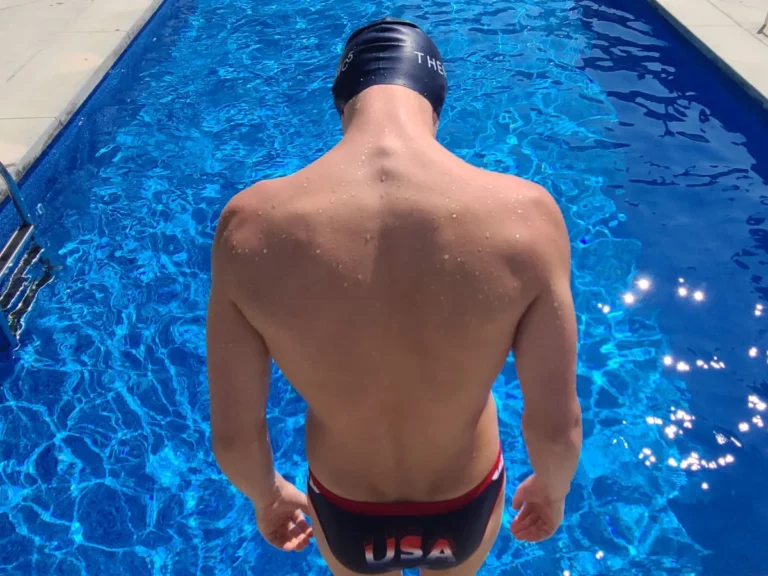
From freestyle to butterfly, learn the basics about the four strokes of competitive swimming. These strokes look simple, but if you know the intricate details, you quickly realize that swimming is not only the most intense sport but also the artistry of each style.
Freestyle Stroke
The Freestyle stroke, often referred to as the front crawl, is one of the most popular and fastest swimming styles. Swimmers use a flutter kick and alternating arm movements to propel themselves forward.
The key to efficient freestyle swimming lies in maintaining a streamlined position, rotating the body to each side during the stroke, and ensuring a continuous breathing pattern. This stroke is commonly seen in competitive swimming races, and mastering it is essential for both speed and endurance in the water.
Backstroke
In the Backstroke, swimmers lie on their backs, and the flutter kick and alternating arm movements are used similarly to the freestyle stroke. What sets backstroke apart is the unique challenge of swimming on one’s back while coordinating the stroke and managing breathing.
Backstrokers rely on the guidance of ceiling markings to swim straight and avoid collisions with pool walls. This stroke showcases a swimmer’s balance, spatial awareness, and mastery of stroke technique.
Breaststroke
Breaststroke is known for its distinctive movements, including a simultaneous arm pull and a “frog kick,” where the legs move outward and then together. This stroke’s rhythmic nature makes it a favorite among beginners and recreational swimmers.
The key to a successful breaststroke is maintaining a streamlined body position, timing the pull and kick correctly, and coordinating breathing with each stroke. Breaststroke is also a part of medley relay events, making it an essential skill for swimmers.
How To Swim Breaststroke
Butterfly Stroke
The Butterfly stroke is often considered one of the most challenging and demanding swimming styles. Swimmers perform a simultaneous arm motion, called the “butterfly pull,” while executing a powerful dolphin kick with both legs.
The key to an effective butterfly stroke is maintaining a continuous, fluid motion with powerful kicks and coordinated arm movements. The undulating movement resembles the graceful flight of a butterfly, but it requires exceptional strength, endurance, and coordination. Mastery of the butterfly stroke is a hallmark of accomplished swimmers.
How To Swim Butterfly
Individual Medley (IM)
The Individual Medley, or IM, is a swimming event that combines all four competitive strokes in a specific order: Butterfly, Backstroke, Breaststroke, and Freestyle. Swimmers must complete each stroke segment before transitioning to the next, making it a comprehensive test of a swimmer’s versatility and skill.
The order of strokes in the IM may vary (e.g., 200 IM or 400 IM), but the challenge remains consistent. IM swimmers need to excel in all four strokes and transitions to excel in this demanding event, making it a true showcase of swimming prowess.