
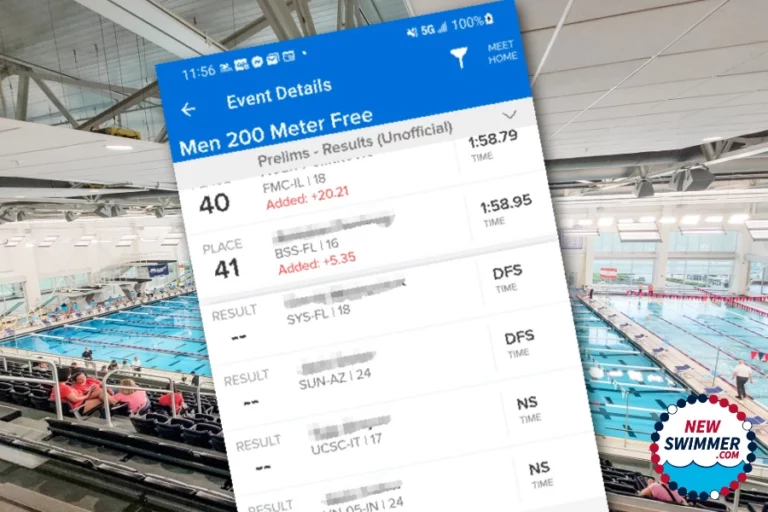
Understanding DFS vs. NS in Competitive Swimming
Competitive swimming has a lot of rules, and knowing them can help swimmers, coaches, and parents avoid costly mistakes. Two important terms swimmers should be familiar with are DFS (Declared False Start) and NS (No Show).
While both indicate that a swimmer did not compete in an event, they have very different consequences.
What is DFS (Declared False Start)?
A Declared False Start (DFS) occurs when a swimmer or their coach voluntarily withdraws from an event before the race begins. This is a proactive withdrawal that must be communicated to the officials before the swimmer’s heat starts.
Key Points About DFS:
- Used when a swimmer decides not to compete in an event they are entered in.
- Must be declared before the race starts to avoid penalties.
- The swimmer’s name will still appear on the results sheet, but it will be marked as DFS instead of a time.
- No penalties are applied for declaring a false start.
DFS is commonly used in prelims-finals meets when a swimmer wants to save energy for another event or if an injury occurs before the race.
What is NS (No Show)?
A No Show (NS) is when a swimmer fails to report to the starting blocks for their scheduled event without declaring a DFS beforehand.
Key Points About NS:
- Happens when a swimmer does not show up for a race they are scheduled to swim.
- Penalties may apply, depending on the meet rules.
- In prelims-finals meets, an NS in a preliminary race can result in the swimmer being barred from the rest of the session.
- In championship meets, an NS in finals can mean being scratched from all remaining events.
DFS vs. NS: What’s the Difference?
Both DFS and NS indicate that a swimmer did not swim in their race, but the difference is communication and consequences.
| Status | Definition | Consequences |
|---|---|---|
| DFS (Declared False Start) | Swimmer voluntarily withdraws before the race starts | No penalty if declared properly |
| NS (No Show) | Swimmer fails to report without notifying officials | Possible disqualification from the next event |
Other Important Competition Terms
Competitive swimming has additional categories similar to DFS and NS that swimmers should be aware of:
SCR (Scratch)
A scratch occurs when a swimmer withdraws from an event before the heat sheet is finalized.
- Most common in prelims-finals meets, where swimmers who qualify for finals may scratch to focus on another race.
- No penalties unless meet rules require commitment to finals.
- Usually done before the session starts to allow alternates to swim.
DQ (Disqualification)
A disqualification (DQ) happens when a swimmer competes in the race but violates a rule.
- Common reasons include false starts, illegal strokes, improper turns, or not finishing correctly.
- The swimmer’s result will show DQ instead of a time.
- DQs are usually called by stroke and turn judges.
DNF (Did Not Finish)
A DNF (Did Not Finish) occurs when a swimmer starts a race but is unable to complete it.
- Can happen due to injury, medical issues, or equipment failure (e.g., goggles falling off).
- Unlike a DQ, a DNF means no official time is recorded.
- Rare but possible in long-distance events if a swimmer becomes too exhausted to finish.
| Status | Definition | Consequences |
|---|---|---|
| DFS (Declared False Start) | Swimmer voluntarily withdraws before the race starts | No penalty if declared properly |
| NS (No Show) | Swimmer fails to report without notifying officials | Possible disqualification from the next event |
| SCR (Scratch) | Swimmer withdraws before the event is seeded | No penalty in most cases |
| DQ (Disqualification) | Swimmer finishes but breaks a rule | Time does not count |
| DNF (Did Not Finish) | Swimmer starts but does not complete the race | No time recorded |
Final Thoughts
Understanding the difference between DFS, NS, SCR, DQ, and DNF can help swimmers avoid unnecessary penalties and keep their focus on racing. Communicating with officials before missing an event is key to avoiding disqualifications or bans from future races.
For swimmers who are unsure whether they should swim or not, declaring a DFS is always the safer option over an NS, especially in highly competitive meets.
By staying informed and making smart decisions, swimmers can ensure they are competing at their best while following the rules of the sport.
For more details on swimming competition rules, check out the USA Swimming Rulebook.
Looking for more definitions and swimming terminology? Visit our Swimming Terminology.
