
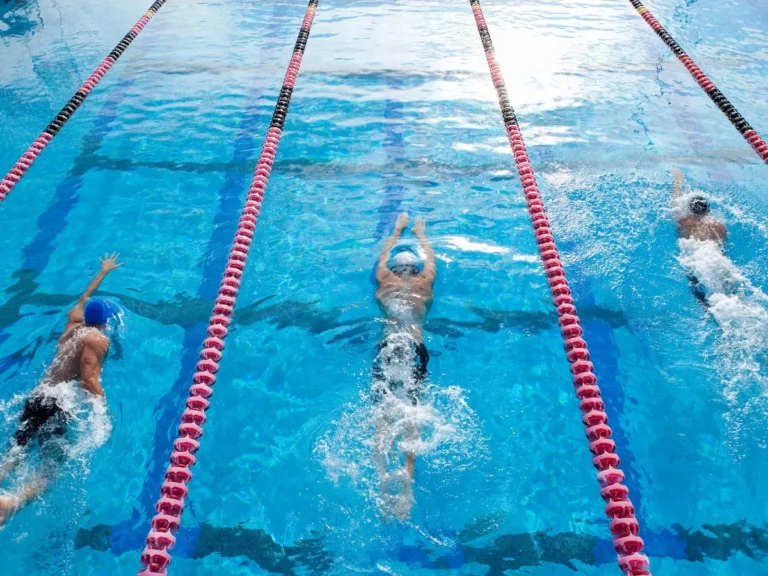
Swim Meet Seeding
Understanding lane assignments and how swimming events are “seeded” can be confusing. Depending on the meet, there are a number of ways your swimmer may be placed in a heat.
Some meets start with the fastest swimmers in the first heat, while others start with the slowest. Depending on the size of the meet and the type of meet, seeding can occur in a number of ways.
There are 3 common types of seeding, regular seeding, circle seeding, and deck seeding.
The most common is regular seeding.
Regular Seeding In Swim Competition
The most common type of meet placement for younger swimmers and club swimming is regular seeding. This means that there are no preliminary and finals events. Your swimmer will swim only once per event which is called a “timed final.”
First, swimmers will be broken down into groups based on times from slowest to fastest and according to the number of pool lanes. Heats will be seeded in groups of 6, 8, or 10 depending on pool size.
Next swimmers will be organized within each heat and given lane assignments. Lanes are filled with the fastest swimmer in each heat being positioned in lane 4. The swimmers are then seeded in descending order until all lanes for the heat are filled.
Here is the order in which Lanes are filled…
- Lane 4, Lane 5, Lane 3, Lane 6, Lane 2, Lane 7, Lane 1, Lane 8 (Fastest to slowest for this heat)

This ensures that swimmers of similar speed are directly next to a competing swimmer of similar ability.
A psych sheet will list each swimmer in their rank from fastest to slowest.
The heat sheet will have the swimmers broken down by heat and seeded by lane assignments.
Circle Seeding In Swim Competition
If the meet has prelims and finals, typically reserved for higher meets and championship meets, circle seeding is preferred.
The concept supposedly gives all swimmers in the top three heats a chance to swim against the fastest swimmers, giving them a better chance at swimming fast and making the finals.
Only the last three heats are circle seeded. In an 8-lane pool, this would mean the fastest 24 swimmers will be distributed throughout the last 3 heats.
The fastest of the 24 swimmers is placed in lane 4 of the final heat.
The second fastest is in lane 4 of the next to the last heat. The third fastest swimmer is in lane 4 of the second to last heat.
The remaining swimmers are seeded in order according to the lane orders
- Lane 4, Lane 5, Lane 3, Lane 6, Lane 2, Lane 7, Lane 1, Lane 8
- Lane 5 is filled, then lane 3, and so on until all 24 swimmers are placed.
- All remaining swimmers are regular-seeded as described above.
Deck Seeding For Distance Swimming
This type of seeding is used for longer events, especially those 400 yards or longer. The purpose of deck seeding is to fill each heat with as many swimmers as possible.
Distance swims tend to be less popular and have fewer entries, although, distance swimming is gaining in popularity in recent years.
Swimmers must “check-in” with the clerk of course (typically located at the scorer’s table) prior to the end of the day’s warm-up session.
If the swimmer doesn’t check in, they will not be placed in a heat and will not be able to swim.